
Hybrid Event Production in New York
Reviewed by Tim Kay, Founder & Director · Updated
In room and remote audiences fully integrated. Camera packages, switching, encoding and remote participant workflows handled end to end by one senior team.
- A production designed for both audiences, not one audience plus a camera
- Remote presenters brought in clean, rehearsed and recorded locally as a safety
- One point of contact from the first technical call through the archive handover
Rooms where a good part of the audience was somewhere else









Hybrid Event Production in New York, Designed for the People Who Are Not in the Room
A hybrid event is not a live event with a camera at the back. It is two audiences watching the same content in completely different conditions, and one of them can leave without anybody in the room noticing.
Argus HD produces both experiences at once. The room gets the stage, the sound and the energy. The stream gets its own cut, paced for a screen, with speaker close ups, readable slides and somebody whose actual job is the audience at home.
We work from 214 W. 29th St. in Manhattan and produce hybrid events at venues, offices and studios across the metro. When the stakes are high, we are the team behind the team.

What Hybrid Event Production Covers
Everything below sits inside one scope, written in plain language after a technical discovery call. Whatever falls within it, we own end to end.
Hybrid Conferences and Summits
Main stage and breakouts produced for the room and the stream at the same time, with a dedicated cut and its own graphics package for the people watching remotely.
Hybrid Town Halls and All Hands
Leadership speaking to a room and a distributed workforce at once, with questions arriving from both sides and reaching the stage the same way.
Remote Speaker Integration
Presenters joining from anywhere at full quality, with a return feed so they can hear the room and be heard cleanly inside it.
Hybrid Panels and Fireside Chats
Panels split between the stage and remote seats, staged and mixed so the conversation still feels like one conversation rather than two.
Multi Room and Breakout Streaming
Several rooms running at once, each with its own crew and stream, coordinated from a single production point so schedules and content stay aligned.
Audience Engagement and Q and A
Polls, moderated chat and a question queue that treats a question typed from a desk the same as a hand raised in the third row.
Virtual Event and Webcast Production
Fully remote events and webcasts at any scale, for the times when a room is not part of the plan at all.
Corporate Event A/V Production
The in room half of your hybrid event. Stage, audio, lighting, projection or LED and show calling, all under the same scope.
Livestream and Broadcast Production
The delivery half. Redundant contribution paths, multi platform delivery and a clean archive handed back afterwards.
Hybrid Is Two Shows Sharing One Room
The room is the easy audience, because it already showed up and it cannot quietly leave. The remote audience is the one you lose, and this is where it usually happens.
Half Your Registrants Never Watch Live
Industry guidance puts roughly half of virtual registrants as no shows on the day, and a good share of those who do turn up drift away inside the first half hour. That is not a technical failure. It is a content and pacing problem, and it gets solved before anyone writes a run of show.
The Stream Needs Its Own Cut
The room gets IMAG, which is a large picture of a person so the back row can see. A screen on a desk needs something different. Speaker close ups, readable slides, lower thirds and a switch that actually moves. One locked off camera at the back of the room is security footage, not a broadcast.
Audio Decides Whether Anyone Stays
People forgive a plain camera angle. Nobody forgives echo, feedback, or an audience question they cannot hear followed by laughter they cannot explain. Room mics, presenter mics, panel mics and the feed to the stream get planned as one system rather than patched together on the day.
Somebody Has to Own the Remote Audience
A host or moderator who acknowledges the people at home, runs the chat and carries their questions to the stage. Without that role the remote audience is watching rather than attending, and watching is a very easy thing to stop doing.
None of this costs much when it is designed in. All of it costs a great deal when it gets discovered on show day.
Designing the Room So Both Audiences Get a Good Seat
Most rooms are chosen for the in person experience and then asked to carry a broadcast as well. A short walkthrough during planning settles almost all of it while changes are still cheap.

What we check in the room
- Camera positions with a clean sightline that does not block the room
- A control position with power, network and a view of the stage
- Ceiling height and rigging points for screens and lighting
- Microphone coverage for audience questions, not only the stage
- Lighting that works on camera as well as it works for the eye
- Bandwidth and a dedicated circuit ordered with real lead time
What the remote audience needs from it
- A speaker close up that reads properly on a laptop
- Slides captured cleanly rather than photographed off a screen
- Room questions audible, so laughter is never unexplained
- A wide shot now and then, so the scale of the room lands
- Holding content during breaks instead of an empty stage
- A visible signal that remote people are present and heard
Bringing Remote Speakers Into the Room
A remote presenter is usually the highest risk element of a hybrid event and the least rehearsed one. We treat them like talent rather than like a video call.
Before the day
- A rehearsal from their actual room, on their actual laptop and connection
- Camera height, framing and lighting fixed while there is still time to fix it
- A wired connection wherever possible, tested at their real upload speed
- A backup path and a phone number that reaches the producer directly
On the day
- A return feed so they can hear the room and follow the cue
- A clean mix minus, so they never hear themselves coming back delayed
- Local recording at their end as a safety against a dropped connection
- A producer on comms with them throughout, not only at the handover
Latency is the part people forget. A remote panelist answering four seconds late reads as hesitation to everyone in the room, so we brief both sides on the delay rather than hoping nobody notices it.
Why New York's Top Teams Choose Argus HD for Hybrid Events
In live production there are no second chances, and a hybrid event politely offers you two different ways to have one.
We do not drop off gear. The same senior team that scoped your event is on comms during it, so the person who found the risk in planning is the person handling it if it ever appears.
You get one point of contact, a scope written in plain language, and problems solved before you see them.
- Full workflow ownership from the first technical call through the archive handover
- One team producing the room and the stream, not two vendors negotiating
- Remote presenters rehearsed properly rather than tested five minutes before
- Failure points found in pre production and eliminated there
- Redundancy built into every critical signal path
- Venue, bandwidth, union and vendor coordination handled for you
- Simple, transparent scopes with nothing new appearing on the invoice
Our Production Process
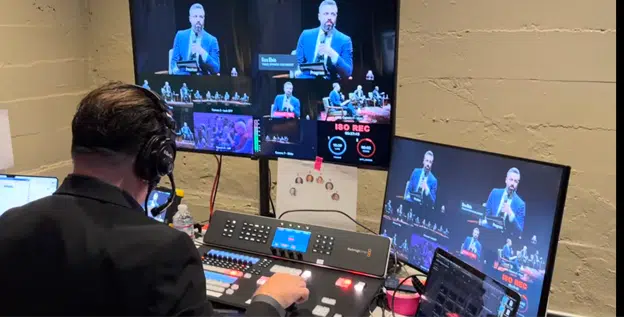
Four stages, one senior team, no handoffs between them. The person who wrote the plan is the person calling the show.
Scope and Strategy
Every production starts with a technical discovery call. We map your venue, both audiences, your signal path and every place something could go wrong.
Two Audience Planning
Run of show, camera plan, stream cut, engagement tools and remote speaker logistics get designed together rather than one after the other.
Rehearsal and On Site Execution
Remote presenters rehearse from their own setup, the failover gets exercised rather than assumed, and senior production leadership runs both shows from load in to wrap.
Archive and Handover
Recordings, stream archives and engagement data handed over clean, plus a short debrief so next year’s event starts ahead of this one.
What Your Scope Actually Includes
Scopes get vague when a vendor wants room to add charges later. Ours are written to be read by the person approving the budget.
On the day
- A production lead and show caller running both audiences
- In room audio, video, lighting and stage crew sized to the room
- A dedicated stream cut with its own switching and graphics
- A remote host or moderator running chat and Q and A
- Remote presenter management on comms throughout
- Live monitoring of the stream exactly as a viewer sees it
After the event
- Clean recordings of every session from the room and the stream
- Stream archive ready for on demand posting
- Isolated audio and camera files on request
- Chat, poll and Q and A exports where those tools were used
- Edited session and highlight cuts when post is in scope
- A written debrief covering what to change next time
Our Fun Fact
Argus HD has been producing live broadcasts since streaming was still figuring itself out. Our founder worked the crew on one of YouTube’s very first live events back in 2008, the Katy Perry show, and later helped bring Facebook’s early F8 developer conferences to a live audience online.
We have been doing live at scale for as long as the platforms have existed, which is why a remote audience never feels like an afterthought on one of our shows.
Productions Where Part of the Audience Was Elsewhere
Shows where a visible failure would have been the story. None of them were.
Google Flutter Developer Event
A large scale developer event in Brooklyn with broadcast and global livestream production.
AI Engineer Summit NY
Two days at The Times Center with livestream and a podcast studio running alongside it.
Board of Directors Meetings
Executive A/V support for private university leadership meetings, with members joining from wherever they were.
The Ezra Klein Show, Live Distribution
Live podcast production for The New York Times with multi platform distribution.


What Hybrid Event Production Costs in New York
Pricing depends on scope, crew size, the number of rooms and how much of the remote experience you want produced rather than simply captured. A single room town hall with a straightforward stream sits at the light end. A multi day conference with breakouts, remote panelists and a fully produced stream cut sits at the other.
We scope it on a technical discovery call and put it in writing in plain language, so the number you approve is the number you pay.
What moves the number
- How many rooms run at once and how many of them stream
- Whether the stream gets its own cut or shares the room feed
- Number of remote presenters and how much rehearsal they need
- Whether a dedicated circuit already exists or has to be ordered
- Engagement tooling, moderation and audience support
- Recording, archive and post production scope
Hybrid Event Production in New York FAQs
Pricing depends on scope, crew size, the number of rooms and how much of the remote experience is produced rather than simply captured. We scope it on a technical discovery call and put the number in writing before you commit, so nothing new appears on the invoice afterwards.
A livestream broadcasts what happens in the room. A hybrid event is produced for both audiences, with its own stream cut, its own host and a way for remote attendees to take part rather than only watch. If your remote audience needs to ask questions, vote or join a panel, you want hybrid.
Industry guidance puts around half of virtual registrants as no shows, and many who do arrive drift away inside the first half hour. The usual causes are pacing designed for a room, a single locked off camera, audience questions nobody can hear, and no one whose job is the audience at home.
Yes. We bring remote presenters in at full quality with a return feed so they can hear the room, a clean mix minus so they never hear themselves coming back delayed, and local recording at their end as a safety against a dropped connection.
On anything longer than an hour, yes. A remote host or moderator runs the chat, acknowledges the people watching and carries their questions to the stage. Without that role your remote audience is watching rather than attending.
Yes. Several rooms can run at once, each with its own crew and stream, coordinated from a single production point so schedules and content stay aligned across all of them.
Venue WiFi almost never carries a broadcast, because upload is thin and contention is high. We specify a dedicated circuit and carry bonded cellular alongside it. Hybrid events are commonly quoted at six to twelve weeks of lead time to get a circuit ordered, so this is an early conversation rather than a late one.
Simpler single room hybrid events can often begin within one to two weeks. Anything involving a dedicated circuit, multiple rooms or several remote presenters wants more, mostly because bandwidth and venue paperwork carry their own deadlines.
Yes. Unlisted links, registration gated portals, domain restricted access and single sign on protected streams are all normal for us. Tell us who is allowed to watch and we will match the platform to that.
Clean recordings from the room and the stream, an archive ready for on demand posting, isolated files on request, chat and Q and A exports where those tools were used, and a short written debrief.
Planning an event where half the audience is somewhere else?
Start with a technical discovery call. We will look at the room, the remote experience and the bandwidth, then put a scope in writing you can take straight to your budget holder.
Argus HD // 214 W. 29th St. 2nd Floor, New York, NY 10001 // info@ArgusHD.com